Understanding Electrical Tracking and Erosion in Polymeric Insulators
Electrical tracking and erosion are two major issues that can affect the performance and lifespan of polymeric insulators. These problems often arise when insulators are continuously exposed to moisture, pollution, and high electrical stress.
What Is Electrical Tracking?
Electrical tracking occurs when conductive pathways form on the surface of an insulator, eventually leading to electrical failure. This typically happens due to the accumulation of contaminants like dust, dirt, salt, acid rain, or other conductive particles. When moisture is present, these contaminants can conduct small amounts of electricity, leading to leakage currents — unintended electrical flows across the insulator's surface.
Over time, these leakage currents generate localized heating, degrading the material and forming carbonized tracks that act as electrical conductors — increasing the risk of insulation failure and potential power outages.
What Is Erosion?
Erosion occurs when the insulator's surface physically degrades due to continuous electrical activity, particularly dry band arcing (DBA). DBA happens when moisture evaporates unevenly from the surface, creating small dry zones that experience intense electrical discharge. These arcs gradually wear away the insulating material, leading to deep cracks, surface roughness, and eventually complete failure.
The Role of Hydrophobicity
Hydrophobicity — the ability of an insulator's surface to repel water — is the first line of defense against tracking and erosion. A hydrophobic surface prevents water from forming continuous conductive layers. If hydrophobicity is lost through aging, contamination, or extreme weather, the insulator becomes far more vulnerable to carbonized pathways and accelerated degradation.
By maintaining the hydrophobicity of polymeric insulators and minimizing contamination, utilities can extend insulator service life and reduce the risk of electrical failures.
Enhancing Insulator Performance with Inorganic Fillers
One effective way to improve durability is by incorporating inorganic fillers into the housing material. These fillers reduce the proportion of organic components in the insulator's structure — particularly the base polymer matrix — making the material more resistant to tracking and erosion.
- Improved electrical resistance — fillers reduce the formation of conductive paths on the surface, lowering the risk of electrical tracking.
- Enhanced mechanical strength — increased toughness makes the insulator more resistant to physical wear and environmental stress.
- Better thermal stability — inorganic particles dissipate heat more effectively, preventing localized overheating that leads to erosion.
- Increased environmental resistance — improved resistance to pollution, UV radiation, and moisture, all of which contribute to surface degradation.
With the right combination of inorganic fillers, composite insulators achieve superior erosion resistance, longer service life, and lower likelihood of insulation failure — a more reliable and cost-effective choice for high-voltage applications in harsh environments.
Testing for Tracking and Erosion
To ensure composite insulators can withstand harsh outdoor conditions, tests simulate real-world electrical and environmental stressors to determine how well materials perform in high-voltage applications.
The Inclined Plane Test (IPT)
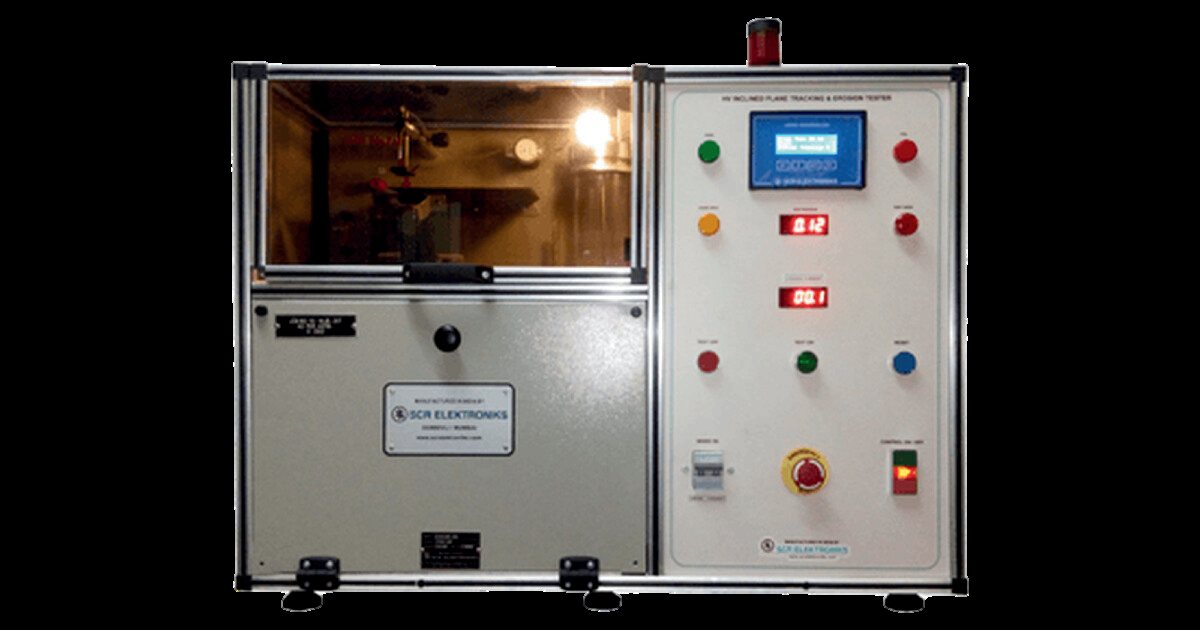
Over the past few decades, the Inclined Plane Test has become the most widely used method for classifying insulation materials based on their resistance to dry band arcing. It follows international standards: IEC 60587 (International Electrotechnical Commission) and ASTM D2303 (American Society for Testing and Materials).
Test Setup
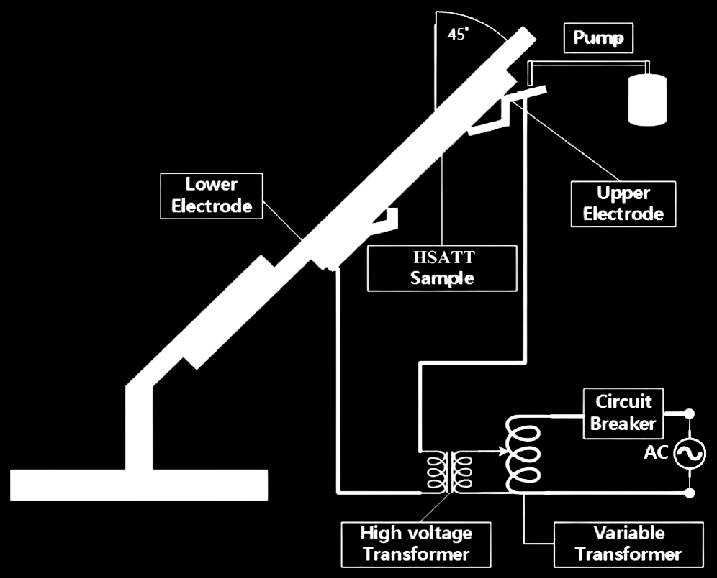
The test involves five flat samples of insulating material, each measuring 5.0 × 12.0 cm with a thickness of 0.6 cm:
- Samples mounted on a PTFE (Teflon) insulating support at an angle of 45° ± 2°.
- Top and bottom electrodes placed 50 mm apart, with a reference line marked at the centre.
- The upper electrode connected to a high-voltage supply through a current-limiting resistor; the lower electrode grounded via a resistance for measuring leakage current.
Creating a Controlled Tracking Environment
To simulate contamination, a conductive liquid is applied to the sample's surface:
- Distilled water
- 0.1% ammonium chloride (NH₄Cl) — to simulate pollution
- 0.02% non-ionic wetting agent — to ensure even distribution
The electrical conductivity of the solution is maintained at 3.95 ± 0.005 Ω·m at 23 ± 1 °C, with filter papers placed beneath the upper electrode to ensure a steady flow of liquid onto the test sample.