
Understanding the EU Market
The European grid is divided into five synchronous regions coordinated by five organisations — NORDEL, BALTSO, UKTSOA, ATSOI and UCTE — each coordinating the TSOs involved at both operational and planning stages. The creation of ENTSO-E (European Network of Transmission System Operators) provides a framework for coordination between the different areas.
The European Union's electricity transmission and distribution (T&D) industry is experiencing significant growth and investment, driven by the need to modernize infrastructure, integrate renewable energy sources, and enhance grid resilience — a complex network of Transmission System Operators (TSOs) and Distribution System Operators (DSOs) responsible for reliable delivery of electricity from generation to consumers.
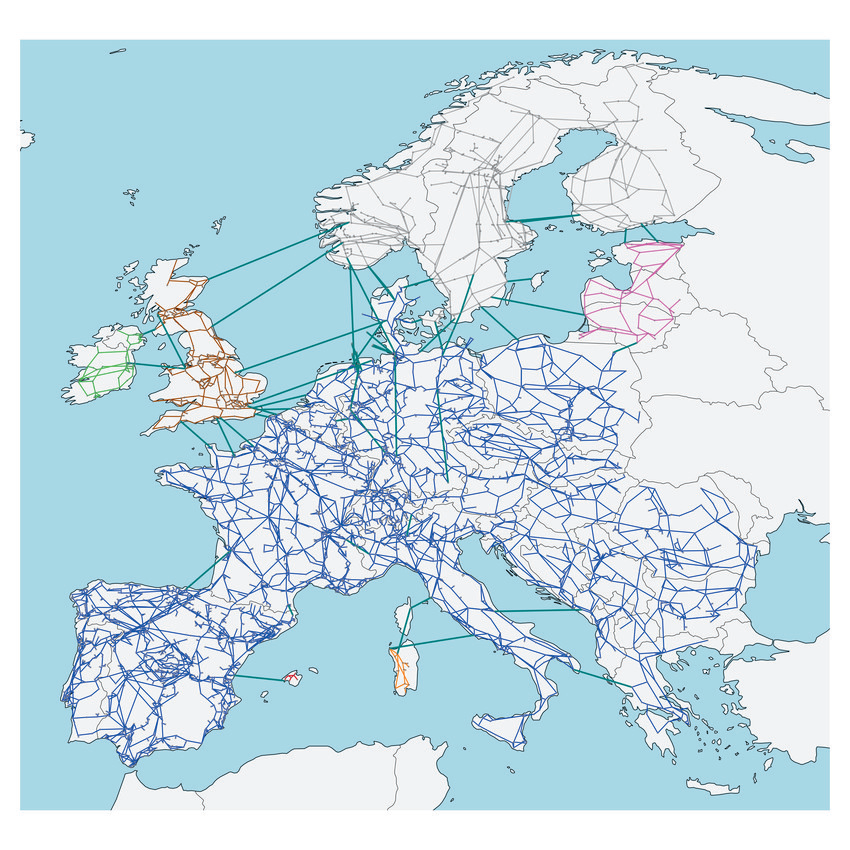
Key Aspects of the EU T&D Industry
Current Landscape & Drivers
Investments and Market Projections
| Category | Forecast / CAGR |
|---|---|
| Grid investments by 2040 | €730 B distribution + €477 B transmission |
| Total grid investment through 2050 | €1.95–2.6 trillion |
| Annual investments needed | €65–100 B/year until 2030 |
| Distribution transformers | ≈4.8–5.9% CAGR |
| T&D equipment market | $43.9 B → $65.2 B by 2030 (5.1% CAGR) |
| Substation market | €12.5 B → €17.8 B by 2034 (3.4% CAGR) |
Notable Projects & Industry Moves
- Siemens Energy plans a €1.2 B investment in its grid unit plus 10,000 hires by 2030.
- UK's Eastern Green Link 2: £3.4 B, 436 km, +2 GW capacity by 2029; National Grid is planning £60 B of investment, while Europe may need ≈€800 B over the next decade.
- Strategic interconnectors: the 700 MW Celtic Interconnector (France–Ireland) launches trials in 2026, with HVDC development advancing on the North Sea backbone (e.g. German offshore-to-shore capacity).
Future Outlook for EU T&D, 2025–2035
1. Investment Trajectory: From Catch-Up to Front-Loading
€584 billion is required by 2030 to modernise EU grids, per the European Commission's 2023 Grid Action Plan — €375–425 billion earmarked for distribution, the remainder for transmission and offshore links. The IEA warns annual grid spending must almost double to ≈USD 600 billion per year before 2030 to stay on track for net-zero. Beyond 2030, cumulative EU grid capex could pass €2 trillion by 2050, implying a sustained €70–90 billion per-year run-rate in 2028-2035.
2. Concrete Project Pipeline
178 transmission schemes and 33 storage projects are already in ENTSO-E's TYNDP 2024, with 108 GW of new cross-border capacity after 2030 and a further 224 GW targeted for 2050. The European HVDC market grows at ≈4% CAGR toward US $2.6 billion by 2030 — flagship corridors include SuedLink, Ost- & NordLink, Viking Link and Eastern Green Link-2. TYNDP's Offshore Network Development Plan identifies 25 GW of hybrid "wind-plus-interconnect" links in the North & Baltic Seas for 2025-40, foreshadowing a meshed North Sea SuperGrid.
3. Digital & "No-Regrets" Efficiency Upgrades
Dynamic Line Rating and other Grid-Enhancing Technologies can raise line capacity substantially and cut system costs 3–5% in high-renewables scenarios; several TSOs (TenneT, REE, 50Hertz) have moved from pilots to fleet deployment since 2024. Work on a pan-EU Digital Twin is advancing, though regulatory fragmentation and data-governance gaps still slow adoption.
4. Flexibility, Storage & Market Integration
Europe's grid-scale storage will jump to ≈45 GW / 89 GWh by 2031 — a 20-fold increase on 2021 — with batteries dominating early deployments and pumped hydro extensions following. All Member States must meet the 15% interconnection target by 2030, forcing late movers (Ireland, Spain, the Baltics) to accelerate HVDC build-outs.
5. Supply-Chain & Workforce Bottlenecks
Transformer lead-times have tripled; Hitachi Energy alone carries a €43 billion backlog and is investing US $6 billion (plus US $250 million in 2025) to expand capacity and hire 15,000 staff. The UK, Germany and Denmark all report project delays linked to equipment shortages and specialised-labour gaps.
Bottom line: the window for the EU to re-wire itself for a net-zero, electrified economy is the 2025–2035 decade. Timely capital, modern permitting, digital intelligence and resilient supply chains will determine whether Europe builds a stronger backbone — or faces a growing reliability gap as renewable ambitions outpace the wires that must carry them.